COMING SOON · WAITLIST OPEN

Lattiform FEA Preview

Finite element analysis, built for the Mac.

Finite element analysis, built for the Mac.

Finite element analysis, built for the Mac.

A linear static stress study on a structured hexahedral grid, solved on your own Mac and published with the residuals, reactions and equilibrium checks that produced it. Metal is Apple’s GPU framework: nothing is uploaded, nothing queues, and every result arrives with the record that proves it converged.

A linear static stress study on a structured hexahedral grid, solved on your own Mac and published with the residuals, reactions and equilibrium checks that produced it. Metal is Apple’s GPU framework: nothing is uploaded, nothing queues, and every result arrives with the record that proves it converged.

Native macOS app

Apple Silicon · Metal

Solves on your Mac

Linear static · HEXA8

Lattiform FEA Preview window showing a solved cantilever study coloured by von Mises stress, with the Results inspector listing legend, deformation, key results and reactions

Real application capture. The built-in cantilever example: 24 × 4 × 4 HEXA8 grid, aluminium 6061-T6, 1 kN tip load, von Mises stress on the deformed shape at 29× exaggeration.

  • Lattiform FEA Preview window showing a solved cantilever study coloured by von Mises stress, with the Results inspector listing legend, deformation, key results and reactions
  • Lattiform FEA Preview showing the deformed cantilever coloured by displacement magnitude at 30× exaggeration
  • Lattiform FEA Preview Supports inspector: a clamped root on the X− face holding 75 of 1875 degrees of freedom at 25 nodes
  • Lattiform FEA Preview Loads inspector: a 1000 N total force on the X+ face spread over 16 element faces
  • Lattiform FEA Preview Preflight panel listing passed checks for grid, material, supports, loads, load path, memory and solver settings
  • Lattiform FEA Preview Geometry and Mesh inspector with extent, element counts, element size and rescale controls
  • Lattiform FEA Preview Material and Units inspector with display units and Aluminum 6061-T6 properties
  • Lattiform FEA Preview Mesh Convergence panel ready to run the bounded 1×, 2×, 4× refinement sequence at a probed node
  • Lattiform FEA Preview export form: output format, camera view with preview, and output resolution
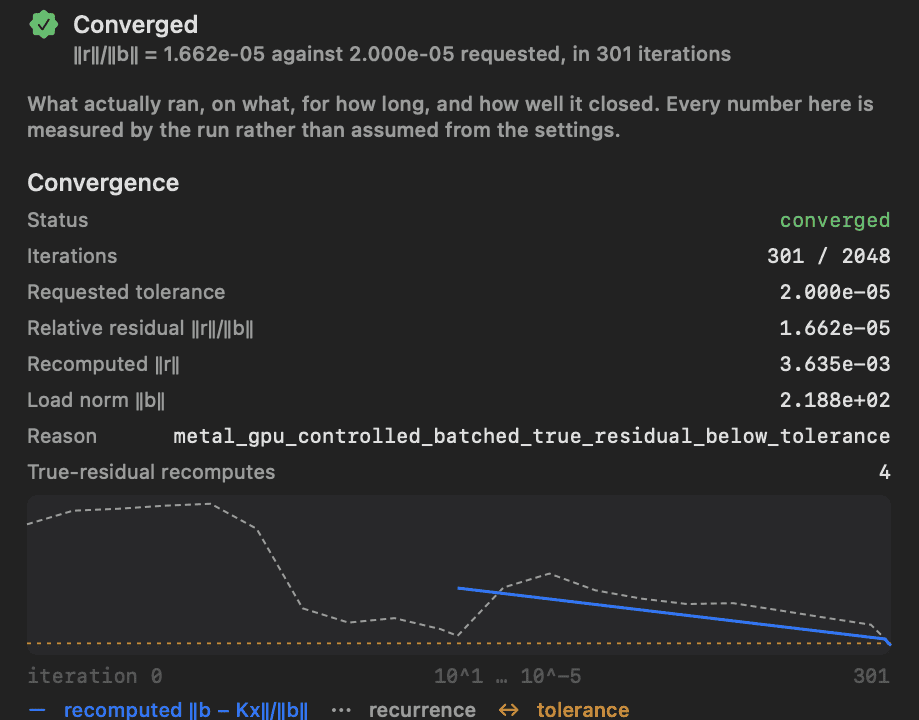
  • Lattiform FEA Preview Validation panel for the solved cantilever: converged status, iterations, requested tolerance, relative and recomputed residuals, stop reason, and the per-iteration residual history chart

WHAT IT DOES

A stress preview that shows its working.

One load step, one material, one body, solved on a structured hexahedral grid. Every result is published together with the convergence record, reactions and equilibrium checks of the run that produced it.

01

Linear static stress

Small-displacement, linear, isotropic elasticity with one load step. Young’s modulus, Poisson’s ratio, density, and an optional yield strength. Without it, the factor of safety is withheld rather than guessed.

02

Structured HEXA8 grid

An axis-aligned grid of trilinear hexahedral elements. Closed STL, OBJ, PLY and OFF meshes are voxelised into it; a supported STEP AP242 single solid uses the native tessellation subset.

03

Supports and loads

Held faces, boxes and reusable named selections. A load is a total force, a force per element or a pressure on a face; gravity is a body load.

04

Local Metal solve

Two Metal lanes on the GPU, single precision with the final residual validated in double, and a double-precision CPU lane, all on this Mac. The host-orchestrated Metal lane is the validated release route.

05

Published diagnostics

Displacement, the stress tensor and its invariants, support reactions and moments, strain energy and an equilibrium residual, each with the convergence record of the run.

06

Mesh convergence probe

A bounded 1×, 2×, 4× refinement sequence at one probed node, so a number can be judged for having settled rather than assumed to have.

FROM STUDY TO RESULT

One study, start to finish.

Scroll through the stages of the built-in cantilever example. The viewport keeps pace, showing the real application at each step.

01 · IMPORT / GEOMETRY

Import / Geometry

Import / Geometry

Geometry & Mesh: extent, element counts, element size, uniform rescale, and removed regions modelled as ersatz material.

02 · SUPPORTS

Supports

Supports

Supports: a clamped root on the X− face holding 75 of 1875 degrees of freedom at 25 nodes, with the held axes chosen per support.

03 · LOADS

Loads

Loads

Loads: a 1 kN total force spread evenly over 16 element faces, with the resultant, direction, loaded area and nominal traction.

04 · PREFLIGHT & SOLVE

Solve

Solve

Preflight: every check decided from the study alone, with the memory estimate against its budget and a connectivity census.

05 · STRESS

Stress

Stress

von Mises stress on the deformed shape: 74.133 MPa maximum at the clamped root (element 31), 3.747 MPa minimum, 28.806 MPa mean over 384 elements, drawn at 29× exaggeration.

06 · DISPLACEMENT

Displacement

Displacement

Displacement magnitude on the deformed shape, exaggerated 30× for the picture only. Every reported number reads the snapshot at true scale.

07 · MESH CONVERGENCE

Refine

Refine

Mesh Convergence: a bounded 1×, 2×, 4× refinement sequence at one probed node, each refinement a separate study and solve, so a number can be judged for having settled.

08 · EXPORT

Export

Export

Export: PNG, GIF or MP4 from the current view, a preset or all standard views, at a chosen resolution; results and convergence also export as CSV.
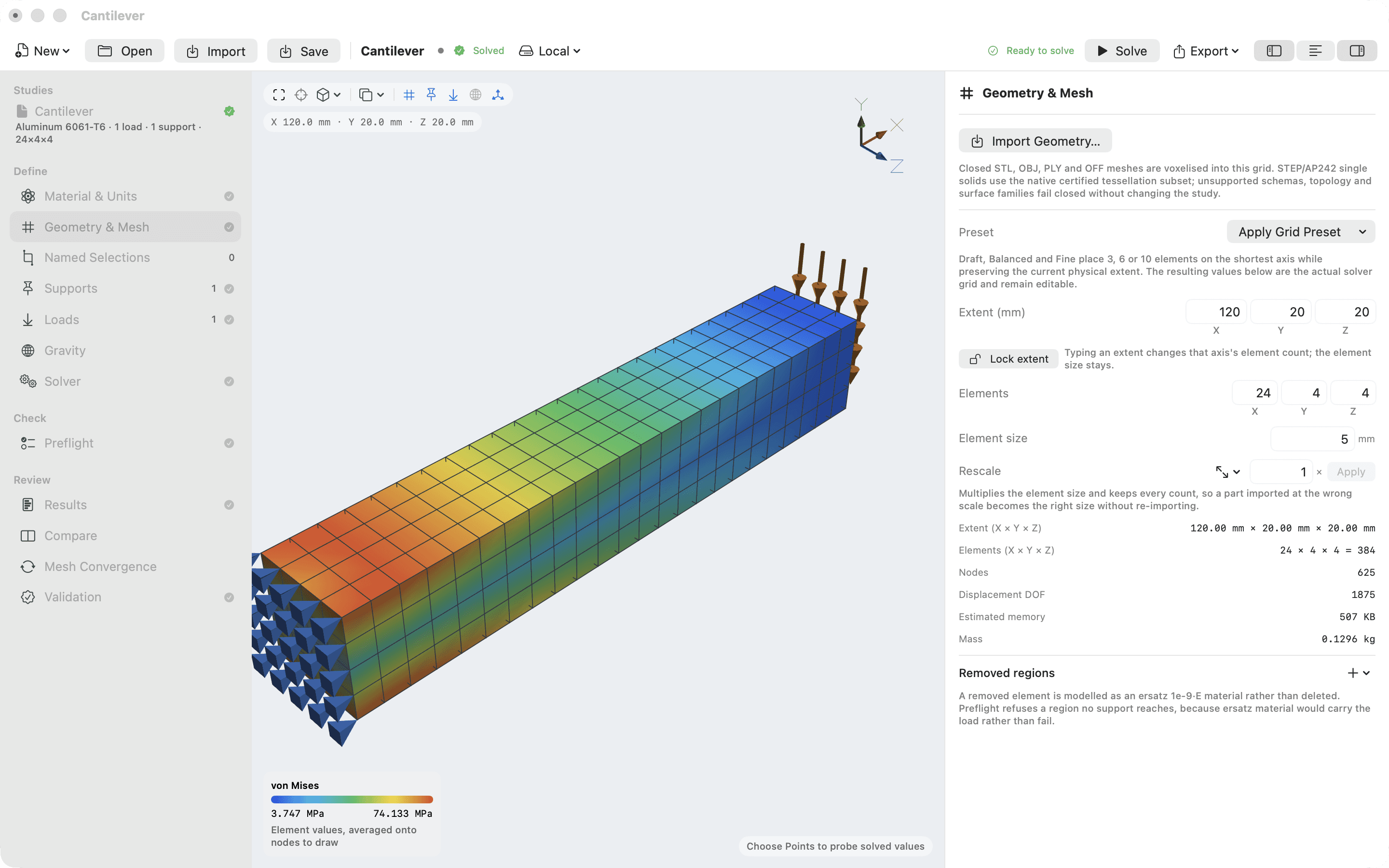
Lattiform FEA Preview Geometry and Mesh inspector with extent, element counts, element size and rescale controls
Lattiform FEA Preview Supports inspector: a clamped root on the X− face holding 75 of 1875 degrees of freedom at 25 nodes
Lattiform FEA Preview Loads inspector: a 1000 N total force on the X+ face spread over 16 element faces
Lattiform FEA Preview Mesh Convergence panel ready to run the bounded 1×, 2×, 4× refinement sequence at a probed node
Lattiform FEA Preview Preflight panel listing passed checks for grid, material, supports, loads, load path, memory and solver settings
Lattiform FEA Preview window showing a solved cantilever study coloured by von Mises stress, with the Results inspector listing legend, deformation, key results and reactions
Lattiform FEA Preview showing the deformed cantilever coloured by displacement magnitude at 30× exaggeration
Lattiform FEA Preview export form: output format, camera view with preview, and output resolution

1 / 8 · Geometry

RESULTS

Inspect the solved study.

Switch between result fields, hover or tap a marker to read what the app reports there, and drag the divider to compare stress against displacement on the same deformed view. Every figure comes from the captures themselves.

Lattiform FEA Preview window showing a solved cantilever study coloured by von Mises stress, with the Results inspector listing legend, deformation, key results and reactions
Lattiform FEA Preview showing the deformed cantilever coloured by displacement magnitude at 30× exaggeration
Lattiform FEA Preview Geometry and Mesh inspector with extent, element counts, element size and rescale controls
Lattiform FEA Preview Supports inspector: a clamped root on the X− face holding 75 of 1875 degrees of freedom at 25 nodes
Lattiform FEA Preview Loads inspector: a 1000 N total force on the X+ face spread over 16 element faces

HOW IT WORKS

Define, preflight, solve, inspect, validate.

The study is the complete solver input. Preflight decides what is missing before a solver starts, and the result is an immutable snapshot of what the solver returned.

Swipe sideways through the five steps.

STEP 1

Define

Set the grid, material, supports and loads. Import a closed mesh or a STEP solid, or start from a built-in example.

STEP 2

Preflight

Grid, material, supports, loads, load path, memory budget and solver settings are checked from the study alone, before a solver starts.

STEP 3

Solve

One press, on this Mac. The solve runs on the GPU or CPU lane you chose, and nothing is sent anywhere to be solved.

STEP 4

Inspect

Colour the model by displacement or stress, probe a node, cut a capped section, isolate a region, pin the legend, animate the deformed shape.

STEP 5

Validate & export

Read the convergence record, equilibrium errors and strain-energy cross-check, run the mesh convergence sequence, then export images, animations and CSV.

STEP 1

Define

Set the grid, material, supports and loads. Import a closed mesh or a STEP solid, or start from a built-in example.

STEP 2

Preflight

Grid, material, supports, loads, load path, memory budget and solver settings are checked from the study alone, before a solver starts.

STEP 3

Solve

One press, on this Mac. The solve runs on the GPU or CPU lane you chose, and nothing is sent anywhere to be solved.

STEP 4

Inspect

Colour the model by displacement or stress, probe a node, cut a capped section, isolate a region, pin the legend, animate the deformed shape.

STEP 5

Validate & export

Read the convergence record, equilibrium errors and strain-energy cross-check, run the mesh convergence sequence, then export images, animations and CSV.

FEA THAT EXPLAINS ITSELF

Every number arrives with the record that produced it.

The Validation panel is the solver’s own record: iterations, residuals, reactions, energy and the reason it stopped, each measured by the run rather than assumed from the settings.

Residuals

The relative residual ‖r‖/‖b‖ against the requested tolerance, the recomputed true residual, the load norm, the iteration count and the reason the solver stopped.

Convergence

A per-iteration residual history: the Krylov recurrence dashed, the recomputed residual solid, the tolerance marked.

Reactions

Applied and reaction resultants, per-support forces, and moments about the grid origin on rest coordinates.

Equilibrium

Force and moment balance errors, the energy identity error and the rigid-body constraint rank, flagged when they leave the expected range.

Strain energy

The solver’s strain energy beside an independent ½σ:ε integration over every Gauss point. Different code, different intermediates; agreement is evidence.

Warnings

Preflight names what blocks a solve. Fallbacks, runtime shader compilation and out-of-range checks are shown in orange, never hidden.

MEASURED, NOT PROMISED

Scaling on one Mac, as measured.

Four frozen size targets on the packaged Metal route, each solved with one discarded warm-up and ten timed repeats on an Apple M5 Pro running macOS 26.5 (release build). Every repeat produced a bit-identical displacement field. These are measurements on that host on that day. They are not guarantees, and no comparison with any other code was measured.

1,000,188

elements in the largest demonstrated run

3,108,864

degrees of freedom in that run

27.898 s

median total wall time for it on the Apple M5 Pro host

Swipe sideways to see every column.

Elements

Grid

Degrees of freedom

Median total (10 repeats)

108,000

120 × 30 × 30

348,843

1.610 s

256,000

160 × 40 × 40

811,923

4.791 s

500,000

200 × 50 × 50

1,568,403

11.675 s

1,000,188

252 × 63 × 63

3,108,864

27.898 s

Source: Lattiform FEA Preview Solver V&V Report V3, summary.json scaling section, run 20260904T112309Z. Regular axis-aligned HEXA8, small-displacement linear isotropic static elasticity, packaged Metal route. Wall time includes setup, solve and result derivation.

VALIDATION & PROOF

One report, every gate named.

The V3 verification and validation report covers one solver route under one stated scope: regular axis-aligned HEXA8 discretisations of small-displacement linear isotropic static elasticity on the packaged Metal route. Every acceptance decision is a named gate with an observed value, a comparator and a limit frozen before the runs.

131

rows PASS

0

rows FAIL

1

row PARTIAL

10

rows NOT SUPPORTED, stated rather than omitted

  • 131 rows PASS

  • 0 rows FAIL

  • 1 row PARTIAL

  • 10 rows NOT SUPPORTED

  • 1,886 gates declared

  • 1,885 gates evaluated

  • 1 gate NOT RUN

  • NASA SP-224(03) problem 1-8-1

  • MSC Nastran Verification Guide 1.1

  • 146 pages

  • Verdict: PASS for the defined release scope

  • Apple M5 Pro host

1,886 declared gates = 1,885 evaluated + 1 NOT RUN. A gate that did not run is never counted as a pass, and a row carrying one is PARTIAL, not PASS.

EXTERNAL CORRELATION · STRUCTURED-GRID ADAPTATION

NASA SP-224(03) problem 1-8-1

Rectangular parallelepiped in pure bending, compared against the five published displacement stations and the published stress distribution. At the finest of five refinement levels (50 × 20 × 5): maximum displacement-station error 0.00289 %, published stress error about 0.00769 %. The same geometry, material, symmetry set and end moment as the source, on a regular HEXA8 grid rather than the source element topology.

EXTERNAL CORRELATION · LOAD-DISTRIBUTION ADAPTATION

MSC Nastran Verification Guide 1.1 straight cantilever

The MacNeal–Harder straight cantilever, against the published theoretical column, at the finest level (96 × 16 × 8): extension 0.120 %, in-plane shear 0.364 %, out-of-plane shear 0.578 % displacement error. The twist case and both distorted-mesh variants are recorded NOT SUPPORTED because this route discretises a regular axis-aligned grid only.

This report is not a certification by ASME, NAFEMS or any other standards body. It claims no equivalence to ANSYS, NASTRAN, Abaqus or any other commercial code. Its thresholds are Lattiform release criteria set by Lattiform.

SCOPE

What it solves, and what it does not.

A preview is not a certification. Nothing here replaces a checked hand calculation, a validated production analysis, or an engineer’s judgement about whether the model is the right one.

Supported

  • Linear elastic, static, one load step, small displacements

  • One isotropic material and one body per study

  • Regular, axis-aligned HEXA8 grid; closed STL, OBJ, PLY, OFF meshes and a supported STEP AP242 single solid, voxelised

  • Homogeneous displacement supports on faces, boxes and named selections

  • Total force, force per element, face pressure and gravity, consistently integrated

  • Displacement, stress tensor and invariants, reactions and moments, strain energy, equilibrium residual

  • Local Metal and CPU backends; bounded 1×, 2×, 4× mesh convergence at a probe

Not supported

  • Plasticity, contact, large deformation or any geometric nonlinearity

  • Dynamics, modal analysis, buckling, fatigue

  • Thermal loading and fluid analysis

  • Anisotropic materials, assemblies, bonded interfaces or joints

  • Curved, inclined, distorted or unstructured elements: surfaces are stair-stepped by the grid

  • Prescribed non-zero displacements

  • Any ASME or NAFEMS certification claim, or any claim of equivalence to ANSYS, NASTRAN or another commercial code

FAQ

Questions engineers ask first.

Short answers, each grounded in the current build and the V3 report.

WAITLIST

Be first to try Lattiform FEA Preview.

Be first to try Lattiform FEA Preview.

Leave your email and we will write when the preview is ready to download. No launch date has been set, and there is nothing to buy yet.

WHAT YOU GET

An invitation to the first build

Updates when the validation evidence changes

A reply address that reaches the developer

For engineers, designers and researchers who want a fast, local linear static check on a Mac. Your address is handled as described on the Privacy page.

Lattiform FEA Preview

Finite element analysis, built for the Mac. Linear static stress studies on a structured HEXA8 grid, solved locally on Apple Silicon with Metal. Coming soon.

Built and validated by Lattiform. Write to beta@lattiform.com with a question or a study file.

© 2026 Lattiform. Lattiform FEA Preview is coming soon. Nothing on this site is a certification by ASME, NAFEMS or any other body, and no equivalence to ANSYS, NASTRAN or any other commercial code is claimed.